Nous utilisons des cookies pour améliorer votre expérience sur notre plateforme. En cliquant sur "Accepter tous les cookies", vous acceptez que des cookies soient stockés sur votre appareil afin d'améliorer la navigation sur le site, d'analyser l'utilisation du site et de nous aider dans nos efforts de marketing.
Cookies nécessaires à la fonctionnalité de base du site web.
Cookies utilisés pour fournir le contenu le plus pertinent pour vous et vos besoins.
Cookies utilisés pour fournir le contenu le plus pertinent pour vous et vos besoins.
Cookies qui aident à comprendre les performances du site web, la façon dont les utilisateurs interagissent avec lui et à identifier les bogues.
Comment Zeffy peut être gratuit ?
Comment Zeffy peut être gratuit ?
Zeffy dépend entièrement des contributions optionnelles des donateurs. Lors de la confirmation du paiement, nous demandons aux donateurs de laisser une contribution optionnelles à Zeffy.
Logiciel pour les organisations à but non lucratif
Avis sur DonorPerfect (2026) : analyse honnête et alternatives gratuites pour les petites associations à but non lucratif
23 mars 2026
De nombreuses petites organisations à but non lucratif repensent leur stratégie de collecte de fonds, se heurtant à des outils tels que DonorPerfect, qui sont très performants, mais dont l'utilisation semble totalement insurmontable. De plus, de nombreux logiciels de collecte de fonds sont coûteux et conçus pour des organisations plus importantes.
Dans cette étude approfondie, nous analysons les points forts de DonorPerfect, les points faibles pour les petites équipes et les raisons pour lesquelles des plateformes comme Zeffy offrent aux organisations à but non lucratif une solution de collecte de fonds simple et gratuite.
DonorPerfect pour les petites organisations à but non lucratif
Il ne fait aucun doute que DonorPerfect regorge de fonctionnalités et de capacités. En même temps, ce qui fonctionne bien pour les grandes organisations avec des équipes dédiées à toutes les fonctions de collecte de fonds (marketing, relations avec les donateurs, programmation, etc.) peut sembler écrasant et chronophage pour les petites équipes.
Toute personne gérant seule la collecte de fonds ou soumise à une pression constante pour faire plus avec moins de ressources peut également ressentir la pression du modèle de tarification de DonorPerfect. Par exemple, comparons-le à des plateformes comme Zeffy, qui ont été conçues spécifiquement pour les petites organisations à but non lucratif :
Zeffy
DonorPerfect
Coût de la plate-forme
$0
À partir de 99 $/mois
Frais de transaction
$0
Non disponible en ligne, mais les frais de transaction moyens se situent entre 2 et 3 %.
Chaque organisation étant différente, nous avons élaboré ce guide pour vous aider à déterminer le meilleur choix pour votre équipe.
Avis sur DonorPerfect (2026) : ce qu'en disent les associations à but non lucratif
Qu'est-ce que DonorPerfect ?
DonorPerfect est un logiciel de gestion des donateurs conçu pour aider les organisations à but non lucratif qui ont besoin d'organiser un grand nombre de données sur les donateurs et les dons, de mener des campagnes de collecte de fonds approfondies et de générer des rapports complexes. Il existe depuis des décennies et est réputé pour son large éventail de fonctionnalités, en particulier pour les grandes organisations ayant des besoins complexes.
Les fonctionnalités de DonorPerfect ont reçu une note de 4,3 /5 sur Capterra, et sont approfondies dans plusieurs domaines de la collecte de fonds, comme par exemple :
Gestion des donateurs
Campagnes de collecte de fonds
Rapports et analyses
Accessibilité mobile
Flux de travail automatisés
Options d'intégration
Tableaux de bord personnalisables
Traitement des paiements
Gestion des événements
Quels sont les avantages et les inconvénients de DonorPerfect ?
Les pros de DonorPerfect pour les petites organisations à but non lucratif
Service à la clientèle
"Le service à la clientèle est extraordinaire. Chaque fois que j'ai besoin d'un rapport compliqué, le personnel d'assistance est capable de me guider jusqu'à ce que j'obtienne ce dont j'ai besoin" - Heather S.
Des caractéristiques robustes
"Nous adorons utiliser DonorPerfect au bureau de développement du Calvert Marine Museum ! Il a transformé la façon dont nous gérons les relations avec les donateurs, en facilitant le suivi des contributions, la gestion des campagnes et l'analyse de nos efforts de collecte de fonds." - Lisa H.
Évolutivité
"La capacité de suivre TOUTES les interactions financières de nos donateurs (c'est-à-dire les dons, les hommages, les achats, etc.). La possibilité d'établir des rapports afin que tous les services avec lesquels j'interagis sachent combien d'argent a été collecté pour leur service et combien pour chaque événement". - Elaine R.
DonorPerfect : les inconvénients pour les petites associations
Rapports
"Il y a quelques aspects du logiciel que nous aimons moins. Les fonctions de reporting, bien que complètes, peuvent être un peu difficiles à personnaliser, et nous avons constaté qu'il faut un peu de temps et de pratique pour les maîtriser complètement." - Lisa H.
Courbe d'apprentissage
"Il y a un certain nombre de problèmes qui semblent systémiques. Par exemple, vous ne pouvez pas ouvrir deux fenêtres pour examiner/comparer deux donateurs, et l'écran de saisie des dons par lots est codé en dur pour ne vous montrer que 10 lignes à la fois, alors que la fenêtre est bien plus grande que cela (et les champs d'en-tête ne restent pas en place lorsque vous faites défiler l'écran vers le bas). Additi
Expérience de l'utilisateur
"Il y a beaucoup à apprendre et généralement peu de temps pour se mettre à niveau pour un nouvel utilisateur, et beaucoup de tierces parties (applications/intégrations partenaires) à suivre, ce qui semble un peu accablant au début". - Corrie M.
Coût pour les petites associations
"Nous sommes une petite organisation à but non lucratif qui n'utilise pas la majorité des fonctionnalités de Donor Perfect. Il serait bien d'avoir une version simplifiée de Donor Perfect disponible avec moins de fonctionnalités pour un coût moindre. - Matt D.
Manque de personnalisation
"La fonction d'émission de reçus n'est pas aussi personnalisable, je ne peux pas modifier les messages individuels comme je peux le faire avec les profils de cadeaux, mais nous avons trouvé une solution de rechange qui convient à notre charge de cadeaux. - Elizabeth O.
Ventilation des prix de DonorPerfect
Pour les petites organisations disposant d'un budget limité, il convient d'évaluer soigneusement les fonctionnalités de la plateforme par rapport à vos objectifs de collecte de fonds.
Combien coûte DonorPerfect par mois ?
DonorPerfect propose plusieurs plans tarifaires, avec des abonnements mensuels à partir de 99 $. Si ce plan d'entrée de gamme peut convenir à certaines petites organisations à but non lucratif, des devis personnalisés sont généralement nécessaires à mesure que vos besoins augmentent.
En outre, des frais de transaction s'appliquent. Bien qu'ils ne soient pas répertoriés publiquement, vous pouvez vous attendre à payer une moyenne de 2 à 3 % par don.
C'est l'une des principales raisons pour lesquelles les petites organisations à but non lucratif sont les plus touchées par les collectes de fonds à tarif zéro. Non seulement elles utilisent gratuitement toutes les fonctions de collecte de fonds, mais elles récupèrent également l'argent qui aurait été consacré aux frais sur d'autres plateformes (même celles qui prétendent être "gratuites").
Calculateur de frais DonorPerfect
Calculatrice Zeffy
Combien vous coûtent les frais de donation de DonorPerfect?
Montant annuel de la collecte de fonds
Montant total des dons que vous collectez en un an (avant frais).
($) USD
Veuillez saisir une valeur
Montant moyen des dons
Facultatif : permet de calculer combien vous perdez par don.
($) USD
Veuillez saisir une valeur
Nous appliquons les frais de traitement de DonorPerfect : 2,89 % + 0,30 $ par transaction. Ce montant n'inclut pas les forfaits d'abonnement (89 $ à 499 $ par mois). Source : tarifs de DonorPerfect en vigueur en 2026.
DonorPerfect vs Zeffy : Lequel est le meilleur pour les petites équipes ?
Zeffy
Zeffy se distingue comme la meilleure alternative à DonorPerfect pour les petites organisations à but non lucratif qui surveillent chaque dollar. Zeffy est conçu pour être simple et répondre aux besoins des petites équipes, sans aucun coût pour les organisations à but non lucratif.
Les fonctionnalités de Zeffy sont disponibles sans paliers ni mises à niveau forcées, et couvrent tous les frais de transaction, ce qui signifie que chaque dollar donné par vos donateurs va directement à votre mission. Vous bénéficiez de toutes les fonctionnalités dont vous avez besoin pour vous développer, mais rien de trop compliqué pour savoir par où commencer.
Zeffy permet aux petites organisations d'organiser des campagnes de transmission aux donateurs sans sacrifier le budget ou l'impact.
Les fonctions 100% gratuites de Zeffy sont les suivantes :
Plus d'alternatives économiques à DonorPerfect pour les petites équipes
En dehors de Zeffy, il est difficile de trouver une alternative gratuite à DonorPerfect. Cependant, il y a quelques options qui peuvent être plus abordables et qui valent la peine d'être examinées au moment de prendre votre décision.
Outil
Meilleur pour
Coût
Zeffy
Les petites organisations à but non lucratif, les nouveaux collecteurs de fonds et tous ceux qui cherchent à maximiser leurs budgets de collecte de fonds grâce à des outils de collecte de fonds 100 % gratuits.
$0
DonorPerfect
Organisations de taille moyenne ou grande ayant des besoins complexes en matière de rapports et de gestion des donateurs
À partir de 99 $/mois + 2 à 3 % de frais de transaction
Bloomerang
Organismes à but non lucratif axés sur la fidélisation des donateurs, l'établissement de relations et l'analyse, disposant d'un budget pour un logiciel de collecte de fonds
À partir de 125 $/mois + 2,9 % + 0,30 $ par transaction
Flipcause
Les organisations à but non lucratif de petite et moyenne taille disposant d'un budget pour la collecte de fonds et recherchant une solution tout-en-un avec une équipe d'assistance.
A partir de 125 $/mois + 1,5 % par transaction (sauf si couvert par les donateurs)
Neon One
Les organisations à but non lucratif en croissance qui ont besoin d'outils personnalisables et d'une solide fonctionnalité de gestion de la relation client et qui sont prêtes à payer un prix modique.
Devis de frais de plateforme personnalisé requis + jusqu'à 2,2 % + 01,25 $ de frais de transaction
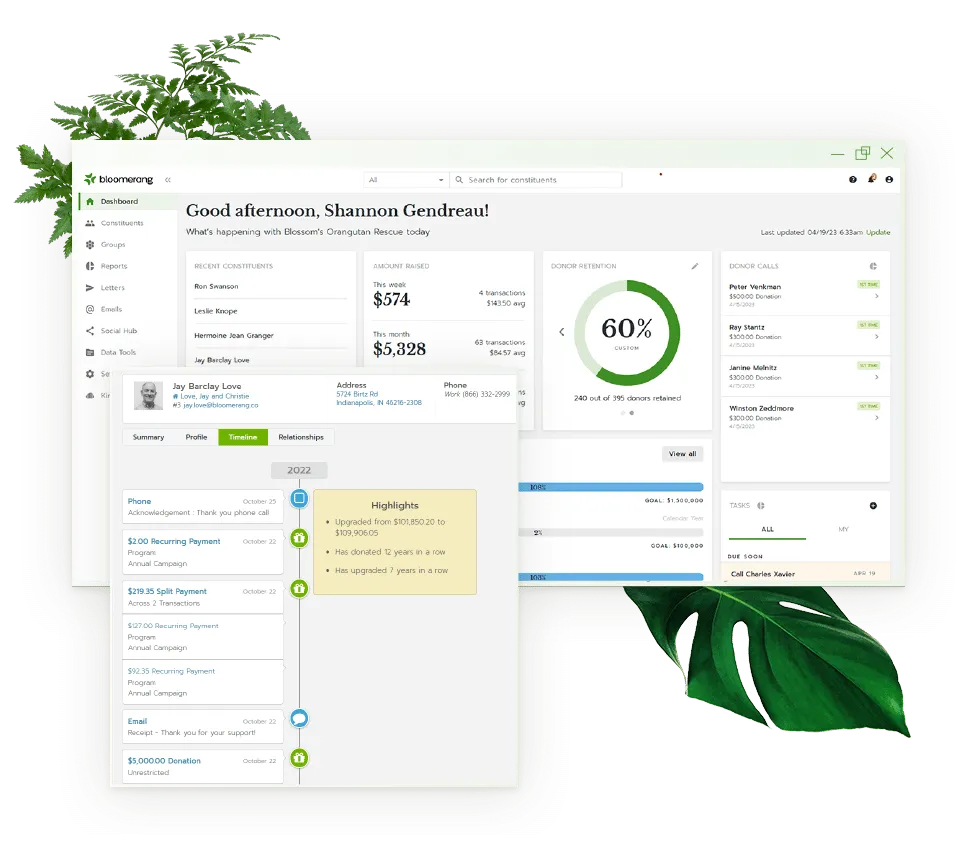
Bloomerang est une plateforme de gestion des donateurs dont l'objectif est d'augmenter la fidélisation et l'engagement des donateurs grâce à des dossiers organisés. Les organisations à but non lucratif à la recherche d'informations exploitables pour construire des relations durables apprécient la plateforme avec ses tableaux de bord conviviaux.
Caractéristiques principales :
Suivre et analyser le comportement des donateurs dans une base de données
Formulaires de dons personnalisables et adaptés aux téléphones portables
Intégrations avec des outils populaires tels que QuickBooks, Mailchimp et Classy
Prix :
Les plans CRM de base commencent à 125 $/mois et vont jusqu'à 775 $/mois. Les fonctions supplémentaires vont de 40 $/mois à 199 $/mois + frais de transaction.
Flipcause est une plateforme tout-en-un de collecte de fonds et de gestion des donateurs spécialement conçue pour les petites organisations à but non lucratif. Elle est connue pour son assistance clientèle pratique et sa facilité d'utilisation pour augmenter l'engagement et organiser d'autres collectes de fonds. La plateforme comprend une assistance à l'installation de type concierge et une suite d'outils de collecte de fonds pour un prix forfaitaire.
Caractéristiques principales :
Collecte de fonds de pair à pair
Gestion d'événements et de campagnes
Suivi des bénévoles et des donateurs pour des décisions éclairées
Intégration du site web et pages hébergées
Prix :
A partir de 125 $/mois (le tarif forfaitaire inclut toutes les fonctionnalités + le traitement des paiements)
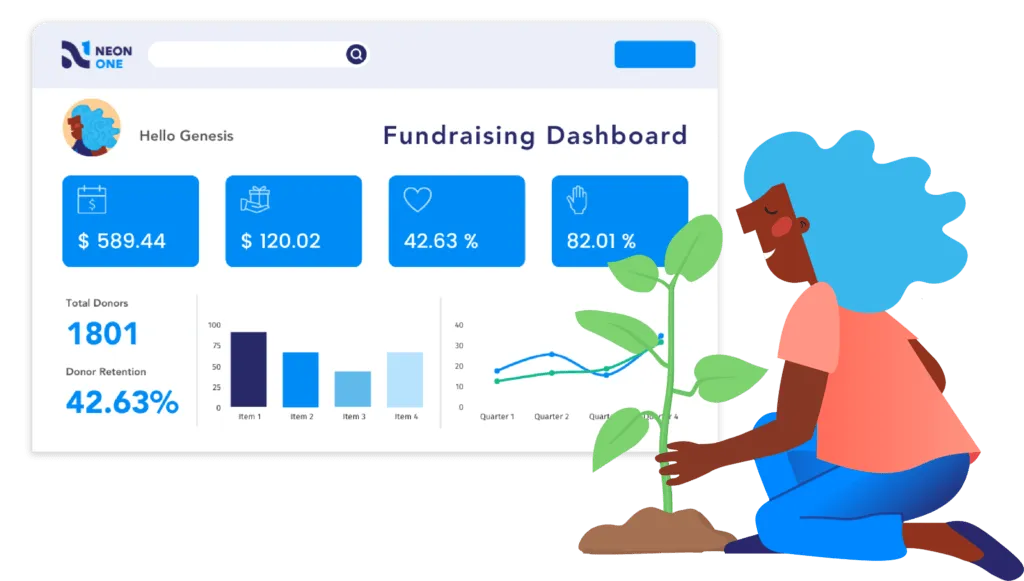
Le CRM de Neon One fournit une suite complète d'outils pour gérer les donateurs, les événements et les campagnes. Conçu pour les organisations à but non lucratif en pleine croissance, il offre de nombreuses options de personnalisation et d'intégration pour répondre à des besoins uniques et vous aider à prendre des décisions plus éclairées. Le coût dépend de votre taille et des fonctionnalités que vous souhaitez utiliser.
Caractéristiques principales :
Formulaires de dons personnalisables
Gestion des adhésions
Gestion des événements
Prix :
Un devis personnalisé est nécessaire pour les frais de plateforme et les frais de transaction.
Trouver une plateforme de collecte de fonds conçue pour les petites organisations à but non lucratif
Allegiance Color Guard est passé d'une solution qui ne correspondait pas vraiment à ses besoins ou à son budget à Zeffy, la seule plateforme 100 % gratuite pour les organisations à but non lucratif. Non seulement ils ont collecté 108 504 $ avec un accès complet aux fonctions gratuites de collecte de fonds, mais ils ont également économisé 5 000 $ supplémentaires en frais de leur ancienne plateforme.
Ressentir la douleur d'un système qui ne tient pas compte de leurs besoins
Avant de passer à Zeffy, l'association dépensait plus de 5 400 dollars par an en logiciels de collecte de fonds. C'est de l'argent que son directeur exécutif savait qu'il aurait pu être mieux utilisé pour soutenir ses membres. Les outils étaient coûteux, complexes et n'offraient pas le soutien dont les petites associations ont besoin.
"Les plateformes que nous utilisions ne communiquaient pas entre elles et n'étaient pas faciles à utiliser pour les bénévoles non techniciens. - Kirsten Miller, directrice exécutive
Économiser 5 425 $ pour atteindre plus d'enfants et développer leur mission
Depuis son changement en 2023, Allegiance a transféré toutes ses opérations de collecte de fonds à Zeffy, économisant ainsi des milliers de dollars et éliminant le besoin d'augmenter les frais d'adhésion. Mieux encore, leur équipe et leurs sympathisants l'adorent.
Cela dépend de vos besoins actuels. DonorPerfect offre de nombreuses fonctionnalités intéressantes, mais son prix de départ est de 99 $/mois, sans compter les frais de transaction. Ce coût (plus la courbe d'apprentissage) peut sembler élevé pour les nouvelles associations ou les petites associations.
Si vous débutez et que vous souhaitez quelque chose de simple, abordable et facile à utiliser pour votre équipe, d'autres plateformes comme Zeffy pourraient être mieux adaptées à votre situation actuelle.
Zeffy est sans conteste la meilleure (et la seule) option 100 % gratuite. C'est la seule plateforme qui ne facture pas de frais de transaction, de frais de plateforme ou de frais de mise à niveau pour les fonctionnalités.
Vous disposez toujours de tous les éléments essentiels à la collecte de fonds, tels que les formulaires de don, l'inscription aux événements, la gestion des donateurs et les outils d'envoi d'e-mails, mais sans frais mensuels.
Oui, DonorPerfect est un logiciel de collecte de fonds et de gestion des donateurs légitime et fiable, utilisé par près de 11 000 organisations à but non lucratif dans le monde.
Les tarifs de DonorPerfect varient en fonction des fonctionnalités que vous souhaitez utiliser. La page des tarifs peut vous aider à trouver les meilleures solutions et les meilleurs devis pour votre association.
Oui, DonorPerfect donne la priorité à la sécurité pour protéger les données des associations et des donateurs. La plateforme protège les informations sensibles par le biais de protocoles, d'un stockage sécurisé des données et d'une conformité aux réglementations sur la confidentialité des données pour plus de sécurité.
La seule plateforme de collecte de fonds 100 % gratuitepour les organisations à but non lucratif
Collectez des fonds avec Zeffy. 100% gratuit, pour toujours.
Merci ! Votre demande a été reçue !
Oups ! Un problème est survenu lors de la soumission du formulaire.
Continuez à lire :
Logiciel pour les organisations à but non lucratif
Avis sur Donorbox 2026 : tarifs, avantages et inconvénients pour les associations qui ne peuvent pas se permettre de perdre 1 475 $ sur chaque tranche de 50 000 $ collectée
Avis authentique sur Donorbox du point de vue d'une association à but non lucratif. Des frais de plateforme de 2,95 % = plus de 1 475 $ perdus sur 50 000 $ collectés avant traitement. Ce que les utilisateurs apprécient, ce qu'ils n'aiment pas et comment la plateforme gratuite de Zeffy se positionne par rapport à Donorbox (+ calculateur de frais Donorbox !)
Logiciel pour les organisations à but non lucratif
Avis sur Zeffy provenant d'organisations à but non lucratif réelles (2026) : notes, avantages et inconvénients
Note de 4,9/5 sur G2. Découvrez les avantages, les inconvénients et les résultats réels des associations à but non lucratif qui utilisent la seule plateforme de collecte de fonds sans frais. Consultez l'analyse complète.
Logiciel pour les organisations à but non lucratif
Avis sur GoFundMe en 2026 : ce qu'en disent les associations (+ calculateur de frais)
Découvrez les commentaires honnêtes d'utilisateurs et d'organisations à but non lucratif sur GoFundMe, les avantages et les inconvénients, les structures tarifaires et les meilleures alternatives pour évaluer votre stratégie de collecte de fonds.
Zeffy est 100% gratuit et le sera toujours. (Nous couvrons même les frais de transaction.) Inscrivez-vous et commencez à collecter des fonds gratuitement dès aujourd'hui.
With Zeffy, 100% of the money you raise goes to your cause. <br>No credit card fees. No platform fees. No fees period.
Saviez-vous que
Collecter des dons sans frais
With Zeffy, 100% of the money you raise goes to your cause. <br>No credit card fees. No platform fees. No fees period.
Des informations sur plus de 100 millions de dollars de transactions mensuelles
Des gains rapides pour vous :
Recherchez des personnes qui assistent à des événements connexes, suivent des groupes Facebook pertinents ou s'abonnent à des bulletins d'information alignés.
Recherchez des personnes qui assistent à des événements connexes, suivent des groupes Facebook pertinents ou s'abonnent à des bulletins d'information alignés.
Comment Loose Ends a transformé les économies de frais en impact sur la mission
$1,715
sauvegardé
1
nouvelle embauche
2500+
projets textiles finis
Il s'agit d'un texte à l'intérieur d'un bloc div.
Il s'agit d'un texte à l'intérieur d'un bloc div.
Il s'agit d'un texte à l'intérieur d'un bloc div.
Il s'agit d'un texte à l'intérieur d'un bloc div.
Il s'agit d'un texte à l'intérieur d'un bloc div.
Il s'agit d'un texte à l'intérieur d'un bloc div.
Il s'agit d'un texte à l'intérieur d'un bloc div.
Il s'agit d'un texte à l'intérieur d'un bloc div.
Il s'agit d'un texte à l'intérieur d'un bloc div.
Il s'agit d'un texte à l'intérieur d'un bloc div.
Il s'agit d'un texte à l'intérieur d'un bloc div.
Il s'agit d'un texte à l'intérieur d'un bloc div.
Rubrique
Rubrique
Rubrique
Rubrique
Rubrique
Toujours dire merci Chaque donateur reçoit un e-mail de remerciement automatique et personnalisé dès qu'il fait un don. C'est rapide, personnel et totalement indépendant.








.webp)

