Nous utilisons des cookies pour améliorer votre expérience sur notre plateforme. En cliquant sur "Accepter tous les cookies", vous acceptez que des cookies soient stockés sur votre appareil afin d'améliorer la navigation sur le site, d'analyser l'utilisation du site et de nous aider dans nos efforts de marketing.
Cookies nécessaires à la fonctionnalité de base du site web.
Cookies utilisés pour fournir le contenu le plus pertinent pour vous et vos besoins.
Cookies utilisés pour fournir le contenu le plus pertinent pour vous et vos besoins.
Cookies qui aident à comprendre les performances du site web, la façon dont les utilisateurs interagissent avec lui et à identifier les bogues.
Comment Zeffy peut être gratuit ?
Comment Zeffy peut être gratuit ?
Zeffy dépend entièrement des contributions optionnelles des donateurs. Lors de la confirmation du paiement, nous demandons aux donateurs de laisser une contribution optionnelles à Zeffy.
How to Fill Out a W-9 for a 501(c)(3) Nonprofit: Step-by-Step Guide
April 20, 2026
⚡TL;DR — La réponse en bref
Verdict: Use your EIN (never an SSN), check "C Corporation" if you're incorporated or "Other" if you're unincorporated, and enter exempt payee code 1 — these three fields trip up most nonprofits.
What works: Completing the form before a payer asks, double-checking your legal name against your IRS determination letter, and keeping signed W-9s on file for every contractor you pay over $600.
What doesn't: Leaving the exempt payee code blank, using a personal SSN instead of your EIN, or checking "Other" when your nonprofit is incorporated as a corporation.
Best for: 501(c)(3) staff and volunteers handling contractor payments, grant reporting, or service agreements for the first time.
Worth considering if: You're also requesting W-9s from contractors — the form works both ways, and this guide covers both directions.
Il arrive que votre association travaille avec d'autres entreprises ou individus pour remplir sa mission - comme lorsqu'un refuge pour animaux s'associe à une clinique vétérinaire pour des services médicaux.
Les organisations peuvent même solliciter l'expertise de votre association, par exemple lorsqu'un district scolaire vous demande des conseils sur les pratiques durables. Ces partenariats s'accompagnent d'exigences spécifiques en matière de rapports, et l'une d'entre elles est le formulaire W-9 de l'IRS - un document simple que votre association doit soit remplir, soit demander à vos partenaires commerciaux.
Dans ce blog, nous examinerons en détail ce qu'est le formulaire W-9, y compris les instructions étape par étape pour le remplir correctement.
Qu'est-ce que le formulaire W-9 et pourquoi les organisations à but non lucratif en ont-elles besoin ?
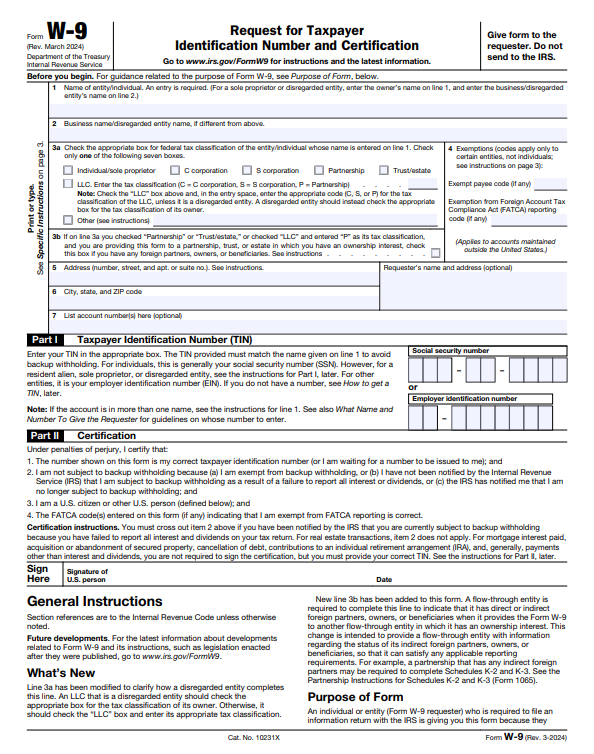
A W-9 form, officially named "Request for Taxpayer Identification Number and Certification," helps nonprofits collect Tax Identification Numbers (TIN) from contractors and businesses they work with. Nonprofits use this information to complete Form 1099, which reports miscellaneous income to the IRS.Source
Le formulaire W-9 est conservé en interne par votre organisation et n'est pas soumis à l'IRS. Il sert à prouver que vous avez recueilli des informations exactes sur le contribuable, nécessaires à l'établissement du formulaire 1099, et constitue une vérification légale des détails fournis.
For example, if you hire a graphic designer for your nonprofit's marketing campaigns and pay them over $600 in a year, you'll need a completed W-9 from them to issue their 1099-NEC during tax filing.
Quand les organisations 501(c)(3) doivent-elles remplir un formulaire W-9 ?
1. Vous travaillez avec un entrepreneur
Lorsque vous travaillez avec un entrepreneur et que vous lui versez plus de 600 dollars, vous devez lui demander un formulaire W-9 au lieu de le remplir vous-même. Ce formulaire contient des informations telles que le NIF et l'adresse postale de l'entrepreneur - informations que vous devrez inclure dans le formulaire 1099, ainsi que le montant que vous lui avez versé.
If you've been working with this contractor for a long time, you can continue using the W-9 form they previously submitted. It's important to regularly review if their information is still accurate – if their address or TIN changes, you'll need to obtain a new W-9 form from them.
2. Vous travaillez en tant qu'entrepreneur
Si votre association fournit des services à d'autres organisations, celles-ci peuvent vous demander un formulaire W-9.
Par exemple, si votre association environnementale offre aux entreprises locales des services de formation rémunérés sur les pratiques durables, ces entreprises auront besoin de votre formulaire W-9. Remplissez et renvoyez le formulaire dans les plus brefs délais afin qu'elles aient le temps de remplir le formulaire 1099.
Procédure en 7 étapes pour remplir un formulaire W-9 pour votre organisation à but non lucratif
Before you start, download the current W-9 directly from the IRS: irs.gov/pub/irs-pdf/fw9.pdf. Always use the latest version — payers may reject outdated forms.
1. Inscrivez votre nom officiel
Il y a deux façons d'indiquer le nom de votre association dans le formulaire W-9 :
Nom de l'entité/du particulier: Indiquez votre nom officiel tel qu'il apparaît sur vos documents de fondation (tels que les statuts).
Nom commercial/nom de l'entité ignorée: n'indiquez le nom de votre organisation, "doing business as" (DBA), que s'il diffère du nom officiel figurant dans vos statuts. Sautez cette section si votre organisation n'a pas de nom d'entreprise distinct.
Par exemple, si votre organisation est constituée en société sous le nom de Youth Environmental Education Foundation of California mais est communément connue sous le nom de Youth Eco Foundation, vous devez écrire "Youth Environmental Education Foundation of California" dans la case 1 et "Youth Eco Foundation" dans la case 2.
2. Specify your organization's tax classification
Le formulaire W-9 vous demande ensuite de sélectionner votre classification fiscale fédérale. Il propose les options suivantes :
Individual/Sole Proprietor: Single-owner business reporting income on personal tax return
C Corporation: Separate legal entity taxed at the corporate level
S Corporation: Corporate entity with special tax status allowing income to pass to shareholders
Partnership: Business owned by multiple individuals sharing tax obligations
Trustee/Estate: Legal entity managing assets with specific tax reporting
Limited Liability Company (LLC): LLCs can choose to be taxed as sole proprietorships (single-member), partnerships (multi-member), or corporations based on their filed elections with the IRS
Other: Unique classifications, including tax-exempt organizations
Here's where many nonprofits get it wrong. The correct selection depends on how your organization is structured:
If your nonprofit is incorporated as a nonprofit corporation under state law and holds 501(c)(3) status, select "C Corporation." Per IRS W-9 instructions, a nonprofit corporation is treated as a corporation for classification purposes on this form — even though you're tax-exempt.
If your nonprofit is unincorporated (for example, an unincorporated association or trust), check "Other" and write your specific exemption type in the field provided — for example, "501(c)(3) nonprofit organization."
This is the single most common source of W-9 errors for nonprofits. When in doubt, check your state formation documents. If you filed articles of incorporation, you're an incorporated nonprofit corporation and should select "C Corporation."
Le code du bénéficiaire exonéré indique si les paiements sont soumis à la retenue à la source. Il s'agit notamment de
Paiements d'intérêts et de dividendes
Opérations de courtage
Opérations de troc
Dividendes de mécénat
Don't leave this blank. Nonprofit organizations exempt under IRS Section 501(a) — which includes all 501(c)(3) organizations — should enter exempt payee code 1 in the "Exempt payee code" box. Code 1 tells the payer your organization isn't subject to backup withholding.
For the "Exemption from FATCA reporting code" box, most domestic 501(c)(3) nonprofits can leave this blank. If your organization has foreign financial account reporting obligations, code A may apply — but this is uncommon for most US-based nonprofits. Check with your accountant if you're unsure.
4. Enter both your address and the requester's address
Le formulaire W-9 comporte deux cases pour indiquer votre adresse. Dans la case 5, inscrivez le nom de la rue de votre organisation, le numéro de la rue et le numéro de l'appartement ou de la suite. Dans la case 6, indiquez votre ville, votre état et votre code postal.
Le formulaire comprend également un espace pour le nom et l'adresse du demandeur. Bien que facultative, cette section permet de savoir quelles organisations détiennent les informations relatives à votre association, en particulier si vous soumettez des formulaires W-9 à plusieurs entrepreneurs.
5. Indiquer le numéro de compte
Votre organisation contractante peut utiliser un système numéroté pour suivre les paiements qu'elle effectue à ses différents partenaires. Si elle a attribué à votre association un numéro de compte spécifique pour son suivi interne, indiquez ce numéro sur le formulaire. Laissez cette section vide si aucun numéro de compte ne vous a été attribué.
6. Mentionner le numéro d'identification du contribuable (Partie I)
Contrairement aux entrepreneurs individuels qui utilisent leur numéro de sécurité sociale, les organisations à but non lucratif doivent utiliser leur numéro d'identification d'employeur (EIN).
Enter your EIN in the "Employer identification number" boxes — never in the "Social security number" boxes. The format is two digits, a hyphen, then seven digits (XX-XXXXXXX). Leave the SSN boxes completely blank.
Si vous n'avez pas encore reçu votre EIN, inscrivez "demandé" dans la section TIN - et dans les 60 jours qui suivent, envoyez votre EIN mis à jour.
Dans la dernière section, vous devez certifier que les informations que vous avez fournies sont véridiques. Vous devez confirmer que :
Vous n'êtes pas soumis à la retenue à la source
Vous êtes un citoyen américain ou une autre personne américaine (y compris les résidents étrangers, les sociétés de personnes, les sociétés de capitaux ou les associations créées ou organisées aux États-Unis, les successions nationales et les fiducies nationales telles que définies par les réglementations de l'IRS).
Vos codes FATCA, le cas échéant, sont corrects
An authorized signer — typically your executive director, treasurer, or board officer — should sign and date the form. Review all information thoroughly before signing and submitting your W-9 form.
Completed W-9 example for a 501(c)(3) nonprofit
Reading through step-by-step instructions is helpful — but seeing a filled-out form makes everything click. Below is an annotated image of a completed W-9 followed by a line-by-line walkthrough of exactly what each field should contain for a tax-exempt 501(c)(3) nonprofit, using a fictional organization as the example.
[ANNOTATED W-9 FORM IMAGE REQUIRED HERE: Insert screenshot of completed IRS Form W-9 with callout boxes annotating each key line — Line 1 (legal name), Line 2 (DBA blank), Line 3 (C Corporation checked), Line 4 (exempt payee code 1), Lines 5–6 (address), Part I (EIN), and Part II (signature). Style consistent with Crowded and Altruic visual guidance.]
Sample organization: Youth Environmental Education Foundation
EIN: 47-1234567
Line 1 — Name
What to write: The organization's full legal name exactly as it appears in your IRS determination letter and articles of incorporation.
✏️ Youth Environmental Education Foundation
Do not use abbreviations here unless your legal name includes them. This must match your IRS records precisely.
Line 2 — Business name / disregarded entity name
What to write: Leave this blank if your organization operates under the same name listed on Line 1. Only fill this in if you use a DBA (doing business as) name that differs from your legal name.
✏️ [Leave blank]
Line 3 — Federal tax classification
What to check: If your nonprofit is incorporated, check ☑ C Corporation. If your nonprofit is unincorporated, check ☑ Other and write "501(c)(3) nonprofit organization" in the space provided.
This is one of the most common sources of confusion on the W-9. Many people assume that because a nonprofit is tax-exempt, it should always check "Other." That's not correct. If your organization filed articles of incorporation with your state, it's a corporation — and the IRS W-9 instructions direct incorporated nonprofits to select "C Corporation."
The "Other" checkbox is reserved for unincorporated tax-exempt entities, such as unincorporated associations or charitable trusts that haven't incorporated under state law. Check your formation documents if you're unsure which applies to your organization.
✏️ C Corporation (if incorporated) — or — Other: 501(c)(3) nonprofit organization (if unincorporated)
Line 4 — Exemptions
Exempt payee code: Write 1 in the "Exempt payee code" box.
Code 1 applies to organizations exempt under Section 501(a), which includes all 501(c)(3) organizations. This tells the payer that your organization is not subject to backup withholding.
Exemption from FATCA reporting code: Leave this blank unless your nonprofit has specific foreign financial account reporting obligations, which is uncommon for most domestic nonprofits.
✏️ Exempt payee code: 1 | FATCA code: [blank]
Lines 5 & 6 — Address
What to write: Your organization's official mailing address — typically your registered address or the address on file with the IRS.
✏️ 123 Green Valley Road, Suite 200✏️ Austin, TX 78701
Part I — Taxpayer Identification Number (TIN)
What to write: Your organization's Employer Identification Number (EIN) in the "Employer identification number" box — never a Social Security Number.
Format: two digits, a hyphen, then seven digits.
✏️ 47-1234567
Leave the "Social security number" boxes completely blank.
Part II — Certification
What to do: An authorized signer — typically your executive director, treasurer, or board officer — signs and dates the form.
✏️ [Signature of authorized representative] | Date: 03/15/2025
Quick-reference summary table
W-9 Field
What a 501(c)(3) Should Enter
Line 1 (Name)
Full legal name per IRS records
Line 2 (DBA)
Leave blank (unless DBA applies)
Line 3 (Tax classification)
☑ C Corporation (if incorporated) or ☑ Other: "501(c)(3) nonprofit organization" (if unincorporated)
Exempt payee code
1
FATCA code
Leave blank
TIN
EIN in XX-XXXXXXX format
SSN boxes
Leave blank
Signature
Authorized officer or representative
The most critical details to get right: select the correct tax classification for your structure on Line 3, enter exempt payee code 1, and always use your EIN — never an individual's Social Security Number. Getting these three fields correct ensures your payers can process the form without follow-up questions and that your organization's tax-exempt status is properly communicated.
Common W-9 mistakes nonprofits make
Even straightforward forms create problems when the instructions aren't written with nonprofits in mind. These are the errors that show up most often — and what to do instead.
Checking the wrong tax classification box
This is the most frequent mistake. Incorporated 501(c)(3) nonprofits should check "C Corporation," not "Other." Many people assume that checking "C Corporation" means they're claiming to be a for-profit company. It doesn't. It simply reflects how your organization is structured legally. If you filed articles of incorporation with your state, you're a corporation — check that box. If you're unincorporated, check "Other" and describe your exemption type.
Leaving the exempt payee code blank
Skipping Line 4 doesn't cause the form to be rejected outright, but it can trigger unnecessary follow-up from payers. It may also lead some payers to apply backup withholding at 24% out of caution. Your organization is exempt from backup withholding under Section 501(a). Enter code 1 and avoid the confusion entirely.
Using a Social Security Number instead of an EIN
This happens most often when a founder or executive director completes the form on behalf of their organization and defaults to their personal information. A W-9 submitted for your nonprofit must use the organization's EIN — not anyone's personal SSN. If your nonprofit doesn't have an EIN yet, write "applied for" in the TIN section and provide the EIN once it's issued.
Using an outdated form
The IRS updates the W-9 periodically. Some payers will reject older versions. Always download the current form directly from irs.gov/pub/irs-pdf/fw9.pdf rather than using a saved copy from a previous year.
Name mismatches between Line 1 and IRS records
If your legal name on the W-9 doesn't exactly match what the IRS has on file for your EIN, it can create TIN validation errors for your payer. Use your name exactly as it appears on your IRS determination letter — including punctuation, "Inc.," or "Foundation" if those words are part of your registered name.
Not updating your W-9 when information changes
A W-9 isn't a one-time filing. If your organization's legal name, address, or EIN changes, you need to provide updated forms to any payers who have your old information on file. Build a habit of reviewing your W-9s on file whenever you go through a significant organizational change.
Do nonprofits need a W-9 for donations and grants?
This question comes up often, and the answer depends on the type of payment your nonprofit receives.
Donations don't require a W-9. When an individual or company makes a charitable contribution to your 501(c)(3), that's a gift — not a payment for services. Donors don't need your W-9, and you don't need to provide one. Your donation acknowledgment letter handles the documentation on your end.
Grants are more nuanced. Most grants from private foundations, community foundations, or government agencies are made to support your charitable mission — and these typically don't require a W-9. However, some grant-making foundations do request a W-9 as part of their due diligence process, particularly when the grant is structured as a payment for specific deliverables or services rather than a general operating grant. In those cases, provide your W-9 promptly so the foundation can complete its own reporting requirements.
Payments for services always require a W-9. If your nonprofit receives payment for providing services — training, consulting, program delivery, or any other work — the payer may need your W-9 to issue a 1099. This applies whether the payer is a corporation, a government agency, or another nonprofit. The threshold is $600 paid in a calendar year.
The simplest rule: if someone is paying your nonprofit for doing something rather than donating to your mission, expect a W-9 request. Keep a completed, current W-9 on file and ready to send. It saves time and prevents payment delays.
Comment soumettre le formulaire W-9
L'envoi du formulaire W-9 varie selon que l'on demande le formulaire ou que l'on vous demande de le remplir. Voici ce qu'il faut faire dans les deux cas :
Lorsque vous répondez à une demande W-9
If a contractor requests the W-9 from your nonprofit, you must complete and return the form as soon as possible, ideally within a week of receiving the request. It won't take long unless you need to apply for an EIN, which takes time.
Après avoir reçu votre formulaire, le demandeur utilisera vos informations pour remplir votre formulaire 1099 et vous l'envoyer avant la date limite du 31 janvier.
Lorsque vous demandez un formulaire W-9
Si votre association demande le formulaire à une autre organisation, précisez comment vous souhaitez recevoir le formulaire signé, que ce soit par télécopie, par courrier électronique ou par des services de documents en ligne.
Une fois que vous avez reçu le formulaire W-9 signé, vous pouvez remplir le formulaire 1099-MISC et l'envoyer à l'organisation contractante et à l'IRS.
Dernières réflexions sur le formulaire W-9
Le formulaire W-9 est essentiel à la conformité fiscale des organisations à but non lucratif, car il constitue un lien vital entre les organisations, les entrepreneurs et l'IRS. Le formulaire recueille des informations essentielles, notamment le nom, le numéro d'identification du contribuable, l'adresse postale et le statut de la retenue à la source.
When working with contractors, request the W-9 form before starting the relationship and verify all information is complete and accurate. Keep these forms secure and updated to accommodate any changes in the contractor's details during your association with them.
Zeffy helps 100,000+ nonprofits manage their fundraising and financial compliance needs at no cost — so your team can focus on mission-critical work instead of paperwork.
FAQ sur le formulaire W-9 pour les organisations à but non lucratif
Le fait de ne pas soumettre un W-9 ou de fournir un TIN incorrect peut conduire les payeurs à retenir 24 % de votre paiement à titre d'impôt. Pour éviter cette retenue d'impôt, veillez à fournir rapidement l'EIN correct de votre association à toute organisation qui vous paie pour des services.
Non, le formulaire 990 et le formulaire W-9 sont différents et ont des objectifs distincts. Le formulaire W-9 recueille les informations d'identification du contribuable pour la déclaration des paiements, tandis que le formulaire 990 est une déclaration d'impôt annuelle que les organisations à but non lucratif remplissent pour conserver leur statut d'exonération fiscale.
Le formulaire W-9 aide les organisations à but non lucratif à déclarer les paiements avec précision, et le formulaire 990 assure la transparence de leurs activités financières.
Les organisations à but non lucratif doivent rendre compte de leurs activités financières et conserver leur statut d'exonération fiscale en remplissant le formulaire 990 de l'IRS. Les exigences en matière de déclaration varient en fonction des recettes brutes annuelles :
* Form 990-N (e-Postcard) for organizations with receipts of $50,000 or less
* Form 990-EZ for organizations with receipts under $200,000 and assets under $500,000
* Form 990 for larger organizations
* Form 990-PF for private foundations
* Form 990-T for nonprofits with unrelated business income over $1,000
Il se peut que votre organisation exonérée d'impôt doive également remplir des formulaires supplémentaires au niveau de l'État, en fonction des lois locales. Si vous ne remplissez pas ces formulaires pendant trois années consécutives, votre organisation perdra automatiquement son statut d'exonération fiscale.
La seule plateforme de collecte de fonds 100 % gratuitepour les organisations à but non lucratif
Collectez des fonds avec Zeffy. 100% gratuit, pour toujours.
Merci ! Votre demande a été reçue !
Oups ! Un problème est survenu lors de la soumission du formulaire.
Continuez à lire :
Guides sur les organisations à but non lucratif
La liste de contrôle de la conformité des organisations à but non lucratif : Un guide pour rester sur la bonne voie
Naviguez en toute confiance dans la conformité des organisations à but non lucratif grâce à notre liste de contrôle complète. Découvrez les exigences légales essentielles, les dépôts et les obligations réglementaires pour les OSBL.
Guide des formulaires 1099 pour les organisations à but non lucratif [2024]
Les organisations à but non lucratif doivent émettre un formulaire 1099 lorsqu'elles font appel à des entrepreneurs indépendants. Découvrez pourquoi les organisations à but non lucratif ont besoin d'un formulaire 1099 et quelles sont les directives précises à suivre pour en émettre un.
Le guide ultime de la déclaration fiscale des organismes à but non lucratif (2024)
Découvrez les conseils essentiels pour la déclaration d'impôts des organisations à but non lucratif en 2024. Apprenez quels formulaires de l'IRS utiliser, les dates limites et les meilleures pratiques pour assurer la conformité et maintenir votre statut d'exonération fiscale.
Zeffy est 100% gratuit et le sera toujours. (Nous couvrons même les frais de transaction.) Inscrivez-vous et commencez à collecter des fonds gratuitement dès aujourd'hui.
With Zeffy, 100% of the money you raise goes to your cause. <br>No credit card fees. No platform fees. No fees period.
Saviez-vous que
Collecter des dons sans frais
With Zeffy, 100% of the money you raise goes to your cause. <br>No credit card fees. No platform fees. No fees period.
Des informations sur plus de 100 millions de dollars de transactions mensuelles
Des gains rapides pour vous :
Recherchez des personnes qui assistent à des événements connexes, suivent des groupes Facebook pertinents ou s'abonnent à des bulletins d'information alignés.
Recherchez des personnes qui assistent à des événements connexes, suivent des groupes Facebook pertinents ou s'abonnent à des bulletins d'information alignés.
Comment Loose Ends a transformé les économies de frais en impact sur la mission
$1,715
sauvegardé
1
nouvelle embauche
2500+
projets textiles finis
Il s'agit d'un texte à l'intérieur d'un bloc div.
Il s'agit d'un texte à l'intérieur d'un bloc div.
Il s'agit d'un texte à l'intérieur d'un bloc div.
Il s'agit d'un texte à l'intérieur d'un bloc div.
Il s'agit d'un texte à l'intérieur d'un bloc div.
Il s'agit d'un texte à l'intérieur d'un bloc div.
Il s'agit d'un texte à l'intérieur d'un bloc div.
Il s'agit d'un texte à l'intérieur d'un bloc div.
Il s'agit d'un texte à l'intérieur d'un bloc div.
Il s'agit d'un texte à l'intérieur d'un bloc div.
Il s'agit d'un texte à l'intérieur d'un bloc div.
Il s'agit d'un texte à l'intérieur d'un bloc div.
Rubrique
Rubrique
Rubrique
Rubrique
Rubrique
Toujours dire merci Chaque donateur reçoit un e-mail de remerciement automatique et personnalisé dès qu'il fait un don. C'est rapide, personnel et totalement indépendant.





.webp)

